

How to Open a Wine Bottle Without a Corkscrew: 6 Safe Tricks


📖 Table of Contents ▼
The safest way to open a wine bottle without a corkscrew is the long screw and pliers method : drive a coarse-threaded wood screw two-thirds of the way into the cork, then slowly lever the screw head upward with pliers or the tines of a fork. If you have no tools on hand, pushing the cork into the bottle with the handle of a wooden spoon is the fastest emergency fix and carries zero risk of shattering the glass.
Sommelier Quick Summary: The key to removing a cork in an emergency is maintaining steady vertical mechanical force. Never pry the cork sharply to the side, as the glass neck can crack or the cork can snap in half.
Why Wine Bottles Use Corks and How the Physics Work
Before trying any emergency trick, it helps to understand why a wine cork sits so tightly inside the glass neck. Natural cork comes from the outer bark of the cork oak tree ( Quercus suber ). This organic material has a microscopic honeycomb cellular structure filled with air, giving it high elasticity and an airtight liquid seal.
When a bottle is sealed at the winery, the cork is compressed to a smaller diameter before insertion. Inside the glass neck, it expands again and creates strong wall friction. That friction protects the wine from excess oxidation for years. Pulling a cork without a straight lever axis creates uneven force that tears the cork in half.
Sommelier Warning: Avoid the Shoe and Lighter Tricks
Social media is full of viral wine-opening clips that look clever but carry a real risk of injury. Before moving to safe techniques, skip these two high-risk methods:
Two Dangerous Tricks to Avoid:
- Banging the Bottle Base Against a Wall in a Shoe: This method relies on hydraulic shock waves in the wine to push the cork out. However, bottle glass thickness is rarely uniform. A slightly angled impact or an unseen micro-fissure can cause the base to shatter instantly, sending sharp glass into your hands and face.
- Heating the Bottle Neck with a Lighter or Blowtorch: Heating the neck aims to expand the air pocket below the cork. In reality, sudden temperature shifts ( thermal shock ) on cool glass can crack the bottle immediately. Direct flame also damages volatile aromas and spoils the flavor profile of the wine.
6 Safe and Proven Ways to Open a Wine Bottle Without a Corkscrew
Here are six tested mechanical alternatives using common household items with minimal risk to the glass bottle:
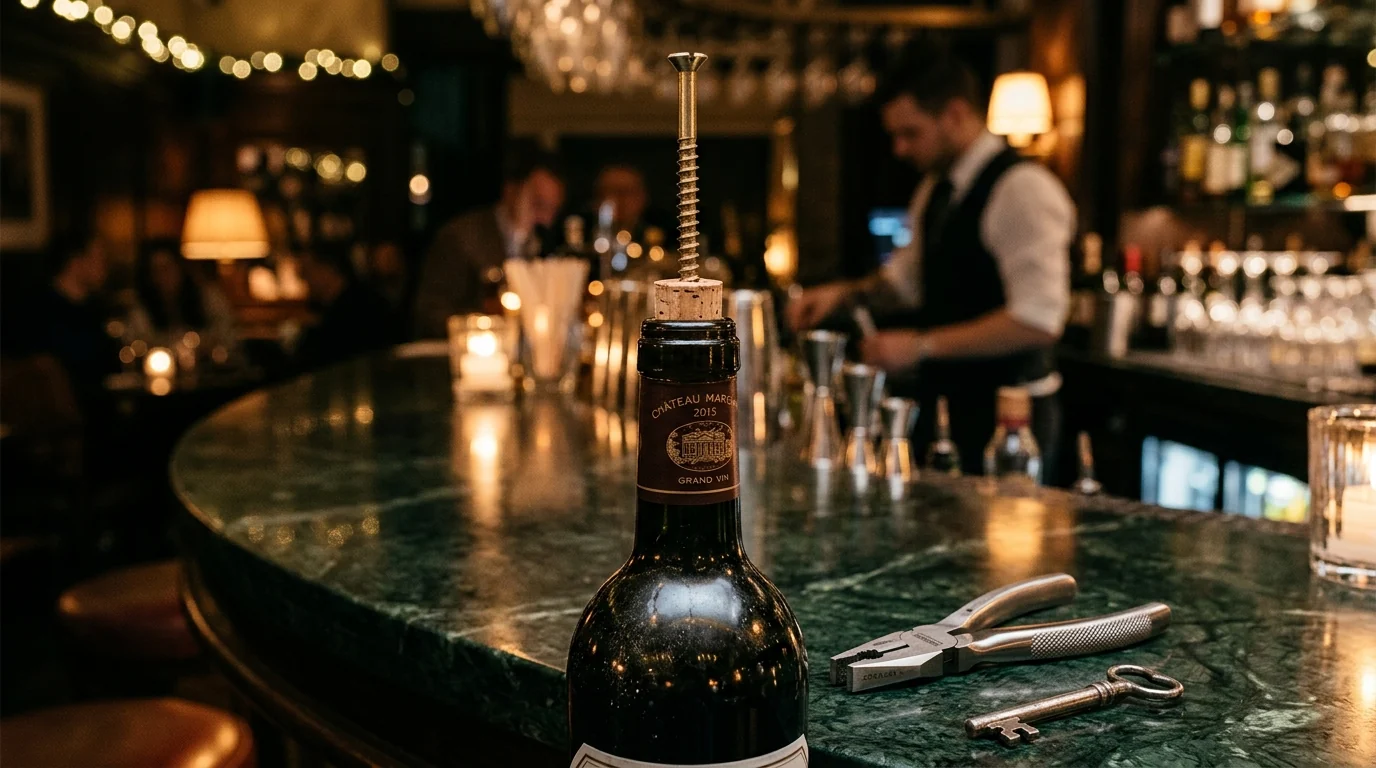
1. Coarse Screw and Pliers (Safest Mechanical Method)
This method is the closest mechanical replica of a professional corkscrew worm. If you are at a house or villa with a basic toolbox, this trick succeeds more than 95 percent of the time.
- Tools: One coarse-threaded wood screw at least 5 cm long, a screwdriver, and pliers or the claw of a small hammer.
- Step 1: Cut away the foil capsule around the bottle neck with a small knife.
- Step 2: Place the tip of the screw dead center on top of the cork.
- Step 3: Drive the screw two-thirds of the way into the cork with the screwdriver, leaving 1 to 1.5 cm of the screw exposed. Do not drill through the bottom of the cork, or cork dust will fall into the wine.
- Step 4: Grip under the screw head with the pliers and pull straight upward steadily while holding the bottle flat on a table.
2. 45-Degree House Key Trick (Practical Travel Fix)
When you are traveling without tools, a sturdy steel or brass house key can act as a spiral lever.
- Step 1: Choose a house key with sharp teeth and a rigid shaft (avoid small padlock keys that bend easily).
- Step 2: Press the tip of the key into the edge of the cork at roughly a 45-degree angle.
- Step 3: Push the key down gently until most of the serrated blade is embedded in the cork.
- Step 4: Twist the key clockwise in a circular motion while lifting upward gradually. Friction will loosen the cork’s grip until it pops free.
3. Serrated Steak Knife Wiggle
A thin, finely serrated steak knife can rotate the cork out from inside the neck.
- Step: Slide the serrated blade between the cork and the glass wall about 2 to 3 cm deep. Rotate the knife slowly in one direction without prying sideways. Once the cork turns and rises halfway out, pull the rest out by hand with a clean napkin.
4. Needle Air Pump (Air Pressure Method)
A basketball pump or manual bicycle pump fitted with an inflation needle can build positive air pressure inside the bottle neck.
- Step: Push the needle straight through the center of the cork until the tip enters the air pocket between the cork and the wine. Give one to three gentle pumps. The trapped air pressure will push the cork upward automatically. Pull the pump out as soon as the cork rises partway.
5. Push-In Method (Fastest Zero-Tool Fix)
When you have nothing to pull the cork upward, pushing it into the bottle is the quickest option with no risk of breaking the glass.
- Step 1: Remove all protective foil from the neck.
- Step 2: Set the bottle on a flat floor over a thick folded towel.
- Step 3: Find a blunt cylindrical object slightly narrower than the bottle neck, such as a thick wooden spoon handle, a permanent marker, or a sturdy dowel.
- Step 4: Wrap a napkin around the neck to catch any wine spray when the air pressure releases.
- Step 5: Press the blunt object squarely on the center of the cork with steady vertical force. The cork will drop inside and float on the wine.
6. Wire Hanger Hook
A flexible yet sturdy wire coat hanger can be bent into a mini hook to lift the cork from underneath.
- Step: Straighten a wire hanger and bend the last 5 millimeters into a 90-degree hook. Slide the wire down between the cork and the glass until the hook clears the bottom of the cork. Rotate the wire 90 degrees to catch the base, then pull upward slowly while wearing a glove or wrapping your hand in a towel.
Comparison Table of Emergency Wine-Opening Methods
The table below compares the efficiency, average time, and risk level of each bottle-opening method:
| Opening Method | Average Time | Success Rate | Glass Breakage Risk | Required Tools |
|---|---|---|---|---|
| Screw and Pliers | 2 minutes | 95 percent | Very Low | 5 cm wood screw, screwdriver, pliers |
| 45-Degree House Key | 3 to 5 minutes | 80 percent | Low | Sturdy serrated house key |
| Serrated Steak Knife | 4 minutes | 75 percent | Low | Pointed serrated steak knife |
| Needle Air Pump | 2 minutes | 85 percent | Moderate (do not over-pump) | Ball pump with inflation needle |
| Push-In Method | 1 minute | 90 percent | Very Low | Wooden spoon handle and cloth napkin |
| Wire Hanger Hook | 4 minutes | 70 percent | Low | Sturdy wire hanger and wire cutters |
First Aid If the Cork Breaks or Crumbles Inside the Bottle
Older natural corks often turn brittle and snap under pressure. If that happens, follow these two rescue steps:
- If Part of the Cork Is Stuck in the Neck: Drive a long screw at a slight angle into the remaining cork piece and pull gently. Avoid jabbing the cork with sharp objects, which only breaks it into smaller crumbs.
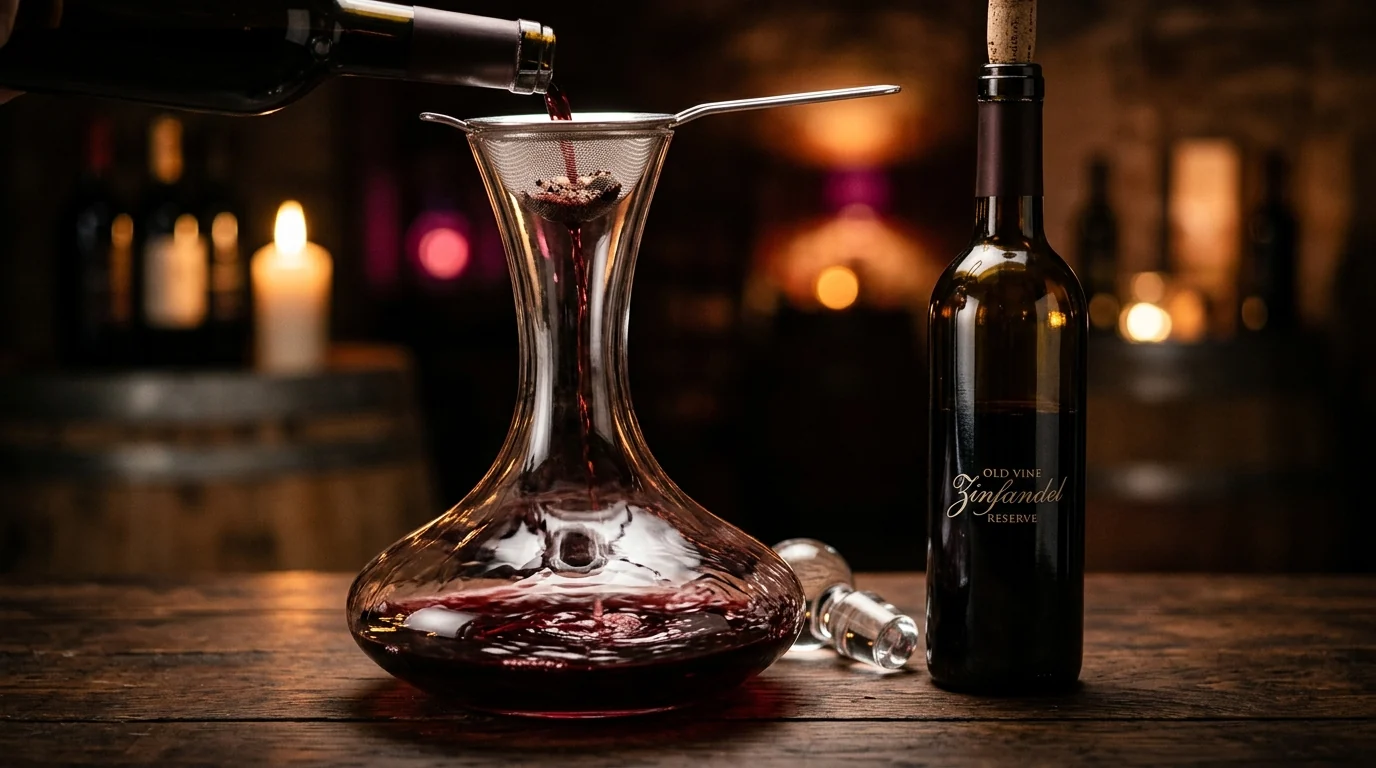
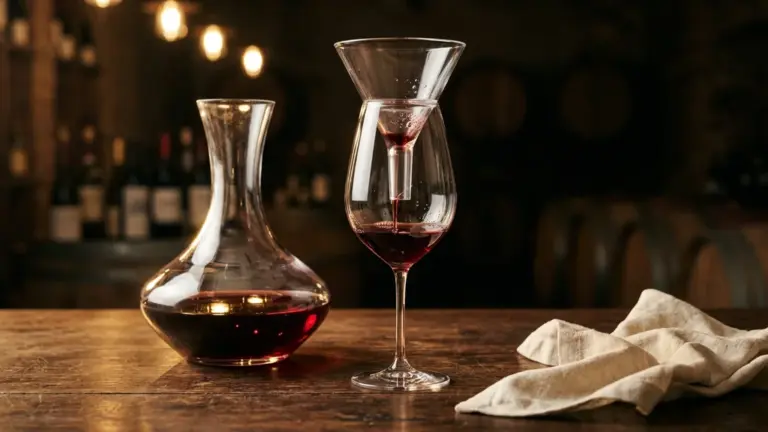
- Straining Out Cork Crumbs: Place a fine mesh strainer or clean cheesecloth over a glass decanter or pitcher. Pour the wine slowly. The mesh catches all cork fragments without stripping the wine’s aroma or flavor.
Once the bottle is open and poured, store any leftover wine at the right temperature. Check our full guide on how long wine lasts after opening .
Traditional Cork vs. Screwcap: When Do You Even Need a Corkscrew?
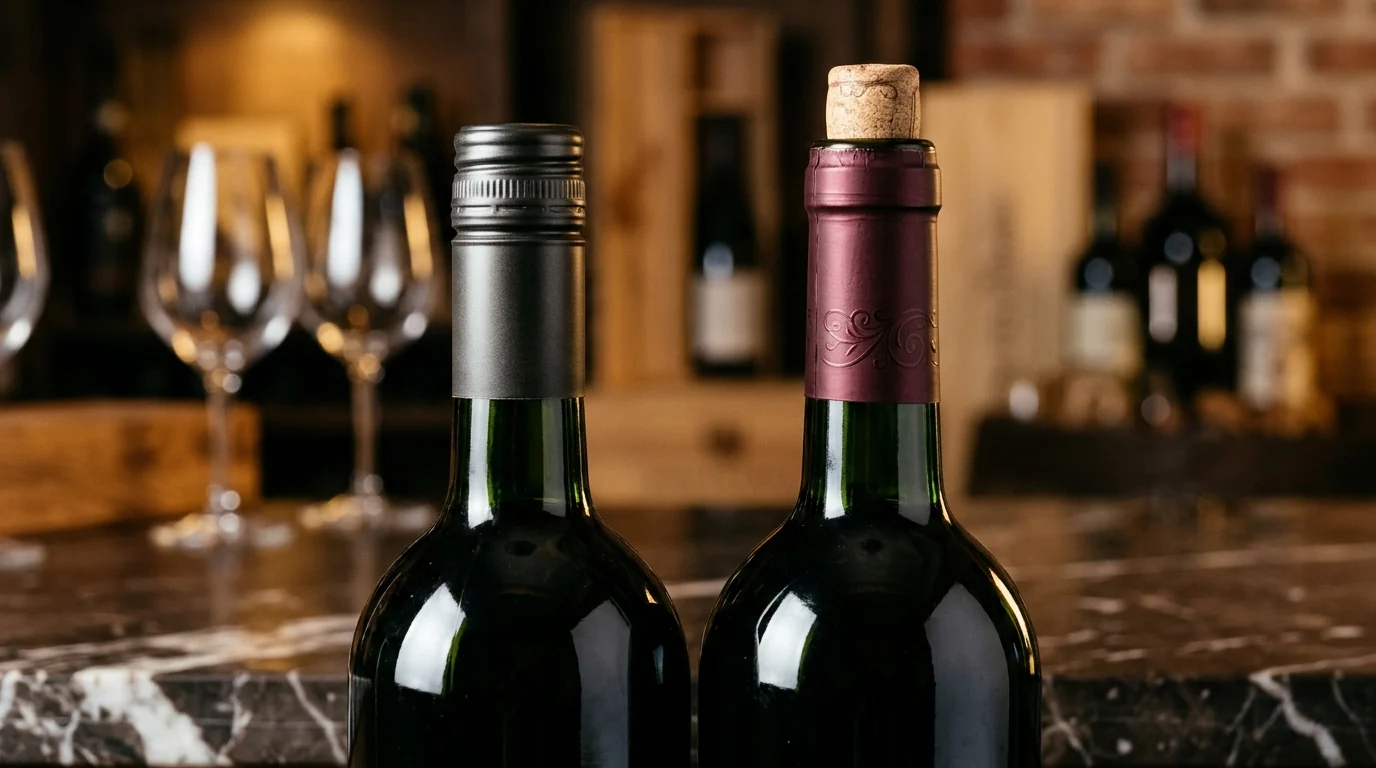
Modern wine drinkers can skip tools altogether by choosing bottles with a screwcap or Stelvin closure . New World producers in Australia and New Zealand pioneered screwcaps to preserve fresh young wines and eliminate cork taint (TCA).
Meanwhile, Old World regions like France, Italy, and Spain still rely on natural cork for bottles meant for long-term cellaring , because microscopic cork pores allow slow micro-oxygenation that softens tannins over the years.
Lindemans Bin 50 Shiraz Australia
A medium-bodied red wine with notes of vanilla and ripe plum. Finished with a convenient twist-off screwcap that needs no opener.
View Bottle at PeakwineMouton Cadet Bordeaux Rouge France
A classic blend of Merlot and Cabernet Sauvignon with fine tannins and a traditional Bordeaux natural cork.
View Bottle at PeakwineFrequently Asked Questions About Opening Wine Bottles
Yes, the wine is completely safe to drink. Wine cork is made from natural, hygienic, non-toxic tree bark. Simply pour the wine through a fine mesh strainer into a decanter to catch the crumbs before serving.
The shoe trick relies on liquid wave reflection, but glass bottles often have invisible micro-fractures. A hard impact at a slight angle carries a high risk of shattering the thick glass base and injuring your hand.
Pushing the cork into the bottle will not ruin the flavor if you serve the wine immediately or pour it into a decanter. Avoid leaving the cork submerged for days, as excess cork tannins can leach into the wine.
You can stock up on sommelier accessories and browse our official selection of screw-cap and natural-cork bottles in the Peakwine wine collection or visit your nearest Peakwine outlet in your city.
Find Your Favorite Wines and Sommelier Accessories at Peakwine
From convenient New World screw-cap bottles to legendary vintage releases sealed with natural cork, Peakwine offers a curated selection of authentic, guaranteed wines with fast delivery across Indonesia.
Explore the Peakwine Wine Collection
Explore Curated Selections for Your Cellar
Authentic wines, spirits, and sake personally curated by our sommelier team with verified provenance and climate-controlled delivery.
Wine Guide Collection
Over 1,300+ red, white, and sparkling wines from acclaimed global producers.
Explore Wine Catalog → Premium SpiritsWhisky, Gin, and Vodka
Rare single malts, blended Scotch, artisan gin, and 100% agave tequila.
Explore Spirits Catalog → Cold-Chain GuaranteedSake and Asian Drinks
Authentic Japanese Daiginjo, Ginjo, Junmai sake and chilled Korean soju.
Explore Sake Collection → Instant Delivery22+ Official Outlets
Find the nearest Peakwine cellar outlet in Bandung and Jakarta for direct pickup.
Find Store Locations →


 By Wine Style
 Red Wine
 White Wine
 Sparkling Wine & Champagne
 Rosé Wine
 Dessert & Sweet Wine
 Fortified & Port Wine
 By Grape Variety
 Cabernet Sauvignon
 Shiraz
 Chardonnay
 Merlot
 Sauvignon Blanc
 Pinot Noir
 Tempranillo
 Sangiovese
 Malbec
 Grenache
 Semillon
 Primitivo
 Moscato
 Carmenere
 Riesling
 Pinot Grigio
 By Country & Region
 Australia
 France
 Chile
 Indonesia
 Italy
 Argentina
 Spain
 United States
 Portugal
 South Africa
 New Zealand
 Japan
 Germany
 By Taste & Sweetness
 Full-Bodied Wine
 Medium-Bodied Wine
 Light-Bodied Wine
 Sweet & Fruity Wine
 Dry Wine
 Curated Collections
 Best Sellers
 Everyday Value (< 500k)
 Reserve & Cellar

 Whisky & Whiskey
 Single Malt Scotch
 Blended Scotch
 Bourbon & Tennessee
 Japanese Whisky
 Irish Whiskey
 Gin
 London Dry Gin
 Dry Gin
 Tequila & Mezcal
 Vodka
 Premium & Craft Vodka
 Indonesian Vodka
 Rum
 White Rum
 Dark Rum
 Brandy Cognac
 Armagnac
 Liqueur
 Traditional Spirit


